
Non-Operative Treatment for Rotator Cuff Tears in Newport Beach
How dry needling and focused shockwave can help you heal without surgery
Rotator cuff pain has a way of creeping into everyday life. It might start as a mild ache after a workout or a long day at your desk, then slowly turn into pain with overhead movement, trouble sleeping on your side, or weakness when lifting even light objects.
For many people in Newport Beach and Orange County, the next question is usually: Do I need surgery?
The honest answer is, not always.
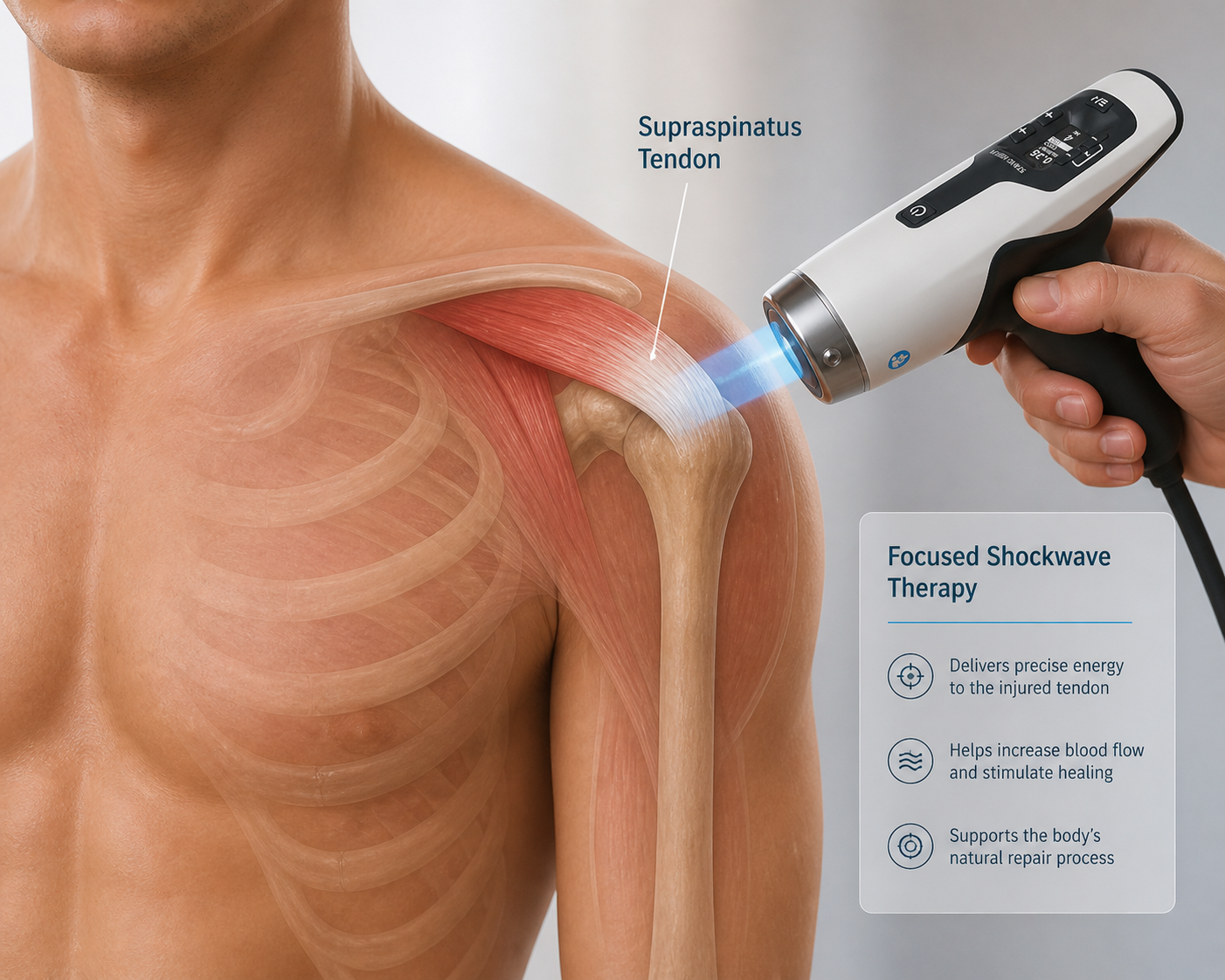
A large percentage of rotator cuff tears, especially partial tears and even some full-thickness tears, can respond really well to non-operative treatment when the approach is right. At our clinic, we focus on combining dry needling and focused shockwave therapy to help the body actually heal instead of just managing symptoms.
What is a Rotator Cuff Tear?
The rotator cuff is a group of four muscles and tendons that stabilize the shoulder and allow smooth movement.
Tears can happen from:
Repetitive overhead activity like tennis, swimming, baseball, or CrossFit
A sudden strain or lifting injury
Gradual wear and tear over time, which becomes more common after age 40
Common symptoms:
Pain when reaching overhead or behind your back
Night pain, especially when lying on the affected side
Weakness or loss of strength
Clicking or catching in the shoulder
Gradual loss of range of motion
If nothing is done, symptoms often progress from occasional irritation to more constant pain, and eventually start affecting the neck, upper back, and even the opposite shoulder.
The Typical Path: Rest, PT, Then Surgery?
Conservative care usually starts with:
Rest or modifying activity
Anti-inflammatories
Physical therapy
And for a lot of people, that works.
But when progress stalls, the next step often becomes a surgical consult. Surgery can absolutely be the right call in certain situations, but it is not a small decision.
A quick look at surgery:
Recovery can take 4 to 6 months or longer
Outcomes vary depending on age, tear size, and tissue quality
Re-tear rates are not insignificant, especially in older patients
Rehab is still required afterward
This is where more advanced non-operative treatments can make a real difference.
How We Approach Rotator Cuff Tears Differently
Instead of only trying to reduce pain, the goal is to stimulate real healing in the tendon.
We do that by combining:
Focused shockwave therapy
Dry needling
These treatments target both the tendon itself and the surrounding muscle system, which is often a big part of why symptoms persist.
Focused Shockwave Therapy: Restarting the Healing Process
Focused shockwave therapy is one of the most effective tools we use for chronic tendon injuries like rotator cuff tears.
How it works:
Shockwave delivers precise acoustic energy into the injured tissue, which:
Increases blood flow to an area that typically has poor circulation
Activates the body’s repair processes
Helps break down degenerative tissue and calcifications
Signals the tendon to restart healing where it has stalled
You can think of it as waking up a tendon that has stopped responding.
What patients usually notice:
Gradual reduction in pain
Improved mobility
Better tolerance to everyday movement
What to Expect with Treatment
This is where setting expectations matters.
Shockwave is not a one-time fix. It works best as a series of treatments, and consistency makes a big difference.
Most patients need about 5 treatments to see significant improvement
Treatments can be scheduled twice per week or up to once per week, depending on your schedule and how quickly you want to move through care
Many people start noticing meaningful changes around treatment 2 or 3
By around treatment 5, we are typically seeing clear pain reduction and improved function
If you want results as quickly as possible, spacing treatments closer together, around twice per week, tends to accelerate progress. Spacing them out once per week still works well, just at a slightly slower pace.
It is also normal to feel a little sore for a day or two after treatment. That is part of the body’s response as it shifts into a more active healing phase.
The goal is not just short-term relief. It is to create lasting change in the tissue.
Dry Needling: Improving Muscle Function Around the Shoulder
Dry needling works really well alongside shockwave.
How it works:
A thin needle is used to target tight or overactive muscle bands in the rotator cuff and surrounding muscles.
This helps:
Reduce muscle tension quickly
Improve blood flow
Restore better muscle activation
Decrease guarding around the injured tendon
Why this matters:
When the surrounding muscles are tight and overworking, they continue to irritate the tendon. Dry needling helps calm that down so the tendon has a better chance to heal.
How This Complements Physical Therapy
These treatments pair extremely well with physical therapy.
Shockwave and dry needling help calm pain and improve tissue quality, which makes it easier to:
Participate more fully in physical therapy
Tolerate strengthening exercises
Move with better control and less compensation
For many people, this combination is what finally allows progress after feeling stuck.
A Patient Story That Stuck With Me
One of our patients, a very active 74-year-old, came in with a rotator cuff tear that had been bothering him for about three months.
It started after something simple. Playing basketball and throwing a ball around with his grandson.
From there:
Pain worsened and started affecting his sleep
He completed about 6 weeks of physical therapy, three times per week
He only saw about 10 percent improvement
At that point, he was understandably frustrated.
We started a series of focused shockwave treatments.
After the third treatment, he was sleeping through the night again
After the fifth treatment, he was essentially pain-free with full function
Six months later, he is still doing great with no return of pain
Physical therapy was not the wrong approach. It just was not enough on its own for where his tissue was at.
What made the difference was adding the right stimulus at the right time.
Other Non-Surgical Options
You may also come across:
Cortisone injections, which can reduce pain short term but may weaken tendon tissue over time
PRP injections
Manual therapy or massage
Activity modification and strengthening programs
Each has its place.
What we focus on is helping the tendon actually repair itself, not just calming symptoms down.
Why This Approach Makes Sense
Your body already knows how to heal.
The issue is that rotator cuff tendons do not have great blood supply, and chronic injuries often get stuck in a stalled healing phase.
These treatments help by:
Increasing circulation
Reactivating the healing response
Improving the muscle environment around the shoulder
Instead of forcing a fix, we are helping the body do what it was meant to do.
Rotator Cuff Treatment in Newport Beach and Orange County
If your shoulder pain is not improving, or you have been told surgery might be your next step, it is worth exploring a more complete non-operative approach first.
At OC Well Studio in Newport Beach, we focus on:
Dry needling for rotator cuff pain
Focused shockwave therapy for tendon injuries
Collaborative care that works well alongside physical therapy
Whether your injury came from tennis, swimming, weightlifting, golf, or just wear and tear over time, there are often more options than you think.
Pain does not always mean something is permanently damaged. Sometimes it just means the tissue needs the right kind of input to truly heal. When you provide that consistently and in the right way, the results can be better than most people expect.
If you are looking for rotator cuff treatment near Newport Beach or Costa Mesa, we are here to help guide you toward the best next step!