
Headache Treatment in Newport Beach, CA
Tired of Headaches That Keep Coming Back?
Most people are told to just manage headaches with medication — but medication doesn't ask why the headache is happening in the first place. Muscular tension, jaw dysfunction, poor posture, and neck restriction are common, treatable drivers that get missed when the only tool being used is a pill or a generic massage.
At OC Well Studio, we start by identifying which type of headache you actually have, then treat the specific muscles and structures driving it — using dry needling, acupuncture, chiropractic care, and postural correction in the combination that fits your case. And if you're hesitant about neck adjustments, you should know: many of our headache patients get excellent results without any cervical manipulation at all.
Common Headache Symptoms
Pressure or tightness across the forehead
Pain at the base of the skull
Aching behind the eyes
Headaches that start in the neck and move forward
Jaw tension or teeth grinding alongside head pain
Headaches that build through the day at a computer
Morning headaches
Neck stiffness accompanying the headac
What Kind of Headache Do You Actually Have?
"Headache" isn't one diagnosis. In your evaluation, we're distinguishing between:
Tension headaches. Driven by tight muscles across the neck, shoulders, jaw, and upper back. These typically feel like pressure or a tight band around the head, often worse by end of day or after long periods of sitting.
Cervicogenic headaches. These originate in the neck itself — often one-sided, starting at the base of the skull, and made worse by certain neck movements. Reduced neck mobility is a telltale sign.
TMJ-related headaches. Jaw clenching and teeth grinding refer pain into the temples, forehead, and even behind the eyes through the muscles used for chewing. Many patients are surprised their headache is coming from their jaw, not their head.
Migraines. More complex and often multi-factorial, but many migraine sufferers see real improvement in frequency and severity when the muscular and postural contributors are addressed alongside their broader migraine management.
Getting this distinction right shapes which structures we actually treat.
A tension headache and a TMJ headache can feel almost identical from the inside — pressure behind the eyes, tightness across the forehead — but one responds to neck and shoulder work and the other barely improves until the jaw is addressed. That's the distinction we're making before we touch a single muscle.
Matching Treatment to What's Actually Driving Your Headache
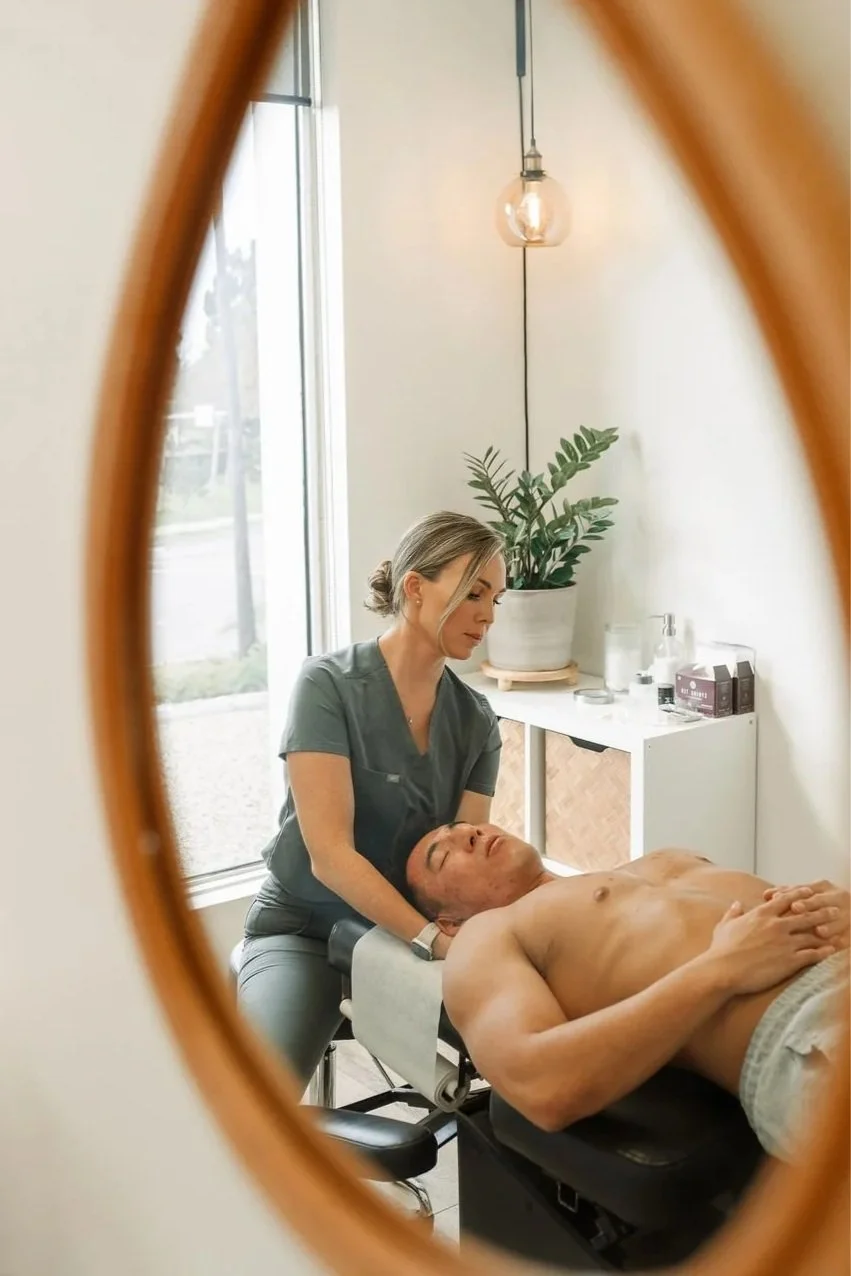
chiropractic, dry needling and massage for headaches in Newport Beach
Dry needling is usually our most direct tool. For tension and TMJ-driven headaches especially, dry needling into the upper trapezius, suboccipitals, temporalis, masseter, and scalenes releases the trigger points that are often the real source of the pain — not just the location where you feel it.
Acupuncture supports the nervous system and stress response. Especially useful for migraine support and stress-related headaches, acupuncture can help calm an overactive nervous system alongside the more targeted muscular work above.
Chiropractic care, without requiring neck manipulation. When appropriate, we work to improve mobility through the upper back and rib cage — patients are often surprised that loosening the upper back reduces strain on the neck and cuts headache frequency, without needing direct cervical adjustment.
Postural correction makes it stick. Long hours at a computer are one of the most common headache triggers we see. We give you specific, practical strategies — not a generic "sit up straight" — to reduce the strain that keeps bringing the headache back.
Who We See
Many of our headache patients come to us after months of medication or generic massage without lasting change — often because the jaw or upper-back component was never addressed. When we treat the actual driver directly, patients frequently notice a difference within the first few visits.
Jaw, Neck, or Both — Our Team Covers It
Because headaches this often trace back to the jaw as much as the neck, we don't want your care limited to one provider's specialty. Our team includes doctors of chiropractic, licensed acupuncturists, and massage therapists trained in myofascial release, so the muscles doing the actual referring — whether that's the masseter, the suboccipitals, or both — get addressed directly. Dry needling into those trigger points is led by Tara Pierce, DC, MACM, LAc, who is certified in the technique.
What to Expect at Your First Visit
A history of when your headaches happen, what triggers them, and where they start
Assessment of neck mobility, jaw tension, and posture to differentiate tension, cervicogenic, and TMJ-driven patterns
Palpation of the neck, jaw, and upper back to identify the specific trigger points involved
Whether tension, cervicogenic, TMJ, or a combination is the driver — since most headache patients we see have more than one contributing factor at once
In most cases, treatment begins the same visit
Frequently Asked Questions
-
Yes. Dry needling is often highly effective for headaches caused by muscle tension, trigger points, and neck or jaw dysfunction.
-
Many migraine sufferers report improvements in frequency, intensity, and overall quality of life with acupuncture as part of their care.
-
No. Many patients achieve excellent results through dry needling, acupuncture, soft tissue treatment, and movement-based care without cervical manipulation.
-
This depends on the type of headache, how long you've had it, and the contributing factors involved. Many patients notice improvement within the first few visits.